
Don't you sometimes wonder whose side Mayors are on? There is concern about low turnout for elections, smaller and smaller proportion of people bothering to vote. Could it be because of growing impressions that politicians, local and central government, have agendas so far removed from what ordinary people without money & influence need, the only time we matter is when our votes can put them into positions of power. Look carefully at the record of basic integrity of candidates, not what they say before an election.
Richard Healey
For almost three years I have predicted a doubling of line charges for the customers of Aurora Energy. More recently I have highlighted the fact that Tim Cadogen's constituents already pay around double the line charges of the people of Dunedin - and only slightly less than double the line charges of customers in the Wakatipu. Tim Cadogen refuses to engage.
A couple of nights ago this happens. Tim Cadogen refuses to engage.
Clearly I need to say this again. It should by now be obvious to everyone that Aurora Energy does not operate a safe and reliable network.
Under the leadership of Richard Fletcher and Steve Thompson, it's clear to me that it continues to demonstrate that it does not have the skills or understanding necessary to identify or remediate the most dangerous structures on its network. It continues to use pole testing systems which, clearly, do not work - and that doesn't just mean Deuar. It continues to "reinforce" poles without having a clue how that changes the ultimate limit state of those structures because it does not take into account the resultant foundation strength.
All of that will be gobbeldy gook to many of you, but it's important to state it in this way because when, as I believe it surely will, this appalling situation results in death or serious injury it will be necessary to show the pattern of behaviour followed by the board and it's managers.
You might have noticed in the past few months that I've backed off Aurora somewhat. That is not because I believe their performance has improved, in my view it certainly hasn't. I've been busy helping some very brave and determined people to try to get justice for 29 men killed in another workplace disaster.
Clearly I need to say this again. It should by now be obvious to everyone that Aurora Energy does not operate a safe and reliable network.
Under the leadership of Richard Fletcher and Steve Thompson, it's clear to me that it continues to demonstrate that it does not have the skills or understanding necessary to identify or remediate the most dangerous structures on its network. It continues to use pole testing systems which, clearly, do not work - and that doesn't just mean Deuar. It continues to "reinforce" poles without having a clue how that changes the ultimate limit state of those structures because it does not take into account the resultant foundation strength.
All of that will be gobbeldy gook to many of you, but it's important to state it in this way because when, as I believe it surely will, this appalling situation results in death or serious injury it will be necessary to show the pattern of behaviour followed by the board and it's managers.
You might have noticed in the past few months that I've backed off Aurora somewhat. That is not because I believe their performance has improved, in my view it certainly hasn't. I've been busy helping some very brave and determined people to try to get justice for 29 men killed in another workplace disaster.
God help me, I hope that I won't soon find myself in a similar position
to the Pike families. If I do it will simply be because of the complete
arrogance of the people involved in the Aurora debacle, but if I do -
God help them too.
____________________________
Thursday, 8 August 2019
Alarm after night of pole failures
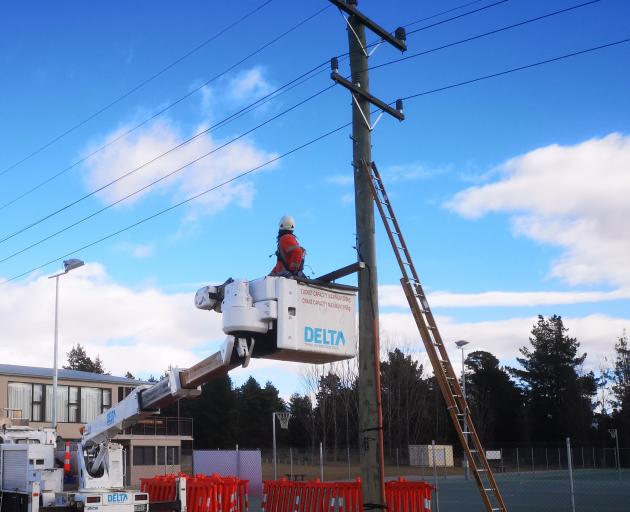
A new power pole is put up outside Alexandra's netball courts on Tuesday morning. Photo: Supplied
The
Vincent Community Board this week approved an urgent, ''last-minute''
motion from board member Russell Garbutt for board chairwoman Sharleen
Stirling-Lindsay to write to Aurora ''to express our concern and
disgust'' about the pole failures....
...Electricity
was cut to 1900 households in the Alexandra and Omakau areas about 7pm
on Monday after a high-voltage pole near the Alexandra netball courts
fell during high winds.
Crews worked through the night and power was restored at 4.27am on Tuesday.
Three
low-voltage poles at the quarry end of Clutha St also fell during the
high winds overnight on Monday, cutting power to 90 customers in that
area.
Power was restored at about 11am on Tuesday....
...But Mr Garbutt said at Tuesday's board meeting he was alarmed by the pole failures.
Mr
Garbutt has led other previous questioning of Aurora, after three poles
fell down in Alexandra in just over three months in 2017, and one in
Clyde about a year later.
An
Aurora delegation headed by chief executive Richard Fletcher
subsequently gave presentations to the board and Central Otago District
Council, earlier this year, after Mr Garbutt challenged Aurora on its
pole testing regime, under-investment in the Central Otago region,
failing network and lack of accountability.
The delegation outlined Aurora's increasing investment in the Otago network........https://www.odt.co.nz/regions/central-otago/alarm-after-night-pole-failures#commentsComments
Jorge
Thu, 08/08/2019 - 9:06am #
Were is workplace or health and safety. It is just criminal to being putting the public in such danger.
Richard Healey
Thu, 08/08/2019 - 9:24am #
Three
years after this train wreck started we have the latest in a
frightening series of asset failures in Alexandra and STILL Tim Cadogen
takes no action on behalf of his community. Even more galling, the
customers in Alexandra are paying twice level of line charges as those
payed by a typical consumer in Dunedin for the privilege of having these
dangerous structures litter their streets.
This is not, and never had been, a simple story of . This is, and always has been, a story of chronic mismanagement.
Diane Yeldon
Thu, 08/08/2019 - 11:00am #
How
Aurora identifies which of its power poles are not up to standard
regarding resistance to an acceptable wind speed. Waits for them to fall
over. They need more than a SMACK for this!

