Saturday, 6 April 2019

Waterfront vision - Ian Taylor in stadium-promoter mode

I'm getting an acute attack of the deja vu's, how about you?


 www.odt.co.nz/opinion/waterfront-bid-platform-future

Waterfront bid a platform for future


With deliberations around Dunedin's provincial growth fund application for the waterfront area reaching their final stages, Duendin businessman Ian Taylor addresses the importance of public debate being informed and factual. 
Ian Taylor

In the coming week the independent assessment panel for the provincial growth fund will meet to consider our application for the waterfront vision.
If the panel were to make its recommendation to Cabinet based on opinion pieces such as the recent offering from Dr Robert Hamlin, a lecturer in the University of Otago's marketing department, and others, we could rest safe in the knowledge that the decades of neglect that has been the hallmark of our waterfront would continue for decades to come.
Fortunately, the panel will be informed by an $820,000 feasibility study and business case paid for by the provincial growth fund.
That's a serious commitment by the Government, not only to our ratepayers, but also to all New Zealand taxpayers who are funding its $3 billion investment in the provinces.
If Dr Hamlin wants rigour in the debate, I can assure him we have had that in spades.
Prepared by independent consultants, the business case is a comprehensive commercial, structural, and environmental feasibility study that was presented to key government agencies in December last year.
Since then, the business case has been the subject of a rigorous evaluation process by the Ministry of Business, Innovation and Employment.
Given the amount of investment we are seeking from the fund, and the competitive nature of applications from across the country, we would expect nothing less..................  
www.odt.co.nz/opinion/waterfront-bid-platform-future

Friday, 5 April 2019

Waterfront vision, costs scrutinised - Rob Hamlin - ODT

Waterfront idea simply fails to stack up


When it comes to Dunedin’s proposed waterfront vision, Robert Hamlin urges everyone to think carefully.
In a recent opinion article Angus Mackay (25.3.19) suggested that the ratepayer contribution to the new waterfront development would be: "linking the cycleways together, inclusion of green spaces, shrubbery, parking, lighting, seating and stormwater flow, but this will likely be a relatively minor cost''.
Indeed? When Forsyth Barr Stadium was proposed, business was to pay all its costs and that consequently no ratepayer funding would be required. Eventually, nearly all of the stadium's costs were funded by ratepayers or taxpayers. Business was just not interested.
The reasons for this are easy to calculate. Assuming a cost of $200million and repayments span of 20 years, the required debt repayment comes to $16.9million a year at 5.9%. Actually, the bill would have been a lot higher because the banks would charge a higher interest rate for risky business proposals. A more realistic commercial interest figure would be 12% - which gives a repayment figure of $26.5million a year.
Then there are the running costs of the stadium, which the DCC is careful to disguise within the workings of DCHL, but which appear (optimistically) to be in the order of $8million a year. This gives us an annual "business'' cost for the stadium of $34.5million a year. Thus a business simply to break even with its "private'' stadium would have required an act to come to Dunedin and pay it a $665,000 fee every week, without fail, for 20 years.
Predictably, businesses did the sums, found this scenario to be wholly incredible and sensibly kept their wallets well out of harm's way. Regrettably, the Dunedin City Council at the time did not do so, as this process came to life.
The current annual cost of the stadium to the ratepayers (assuming the lower interest rate) appears to be around $25million a year. This is a straight loss, as it appears that this is not in any way offset by revenue as it seems DVML pays its occasional acts to use the stadium rather than the other way around.
One has to rely on indirect analysis, as the nature and direction of any stadium-related fees paid are "confidential'', to put it mildly. Most of this loss goes straight out of the city as debt repayments, which are not included in any economic impact assessments of the stadium.
All this being said, the stadium is a "sunk cost'' that is powerfully backed by its proponents. However, we should heed the lessons of it, in order to avoid a repetition. This community, now approaching a billion dollars in debt and with a catastrophically and strategically neglected infrastructure, simply cannot take another ``hit'' of this magnitude.
This is why we need to carefully examine this latest "whizz-bang'' proposal that will apparently cost us a few cents. One look at these designs would suggest that no private onshore developer would construct this design given the extravagant nature of the structures and the terrain on which they are to be built. The hydraulically deposited mud in this location is hundreds of feet deep, and new land will have to be created in this hostile environment before these ferro-concrete extravaganzas can be placed upon it.
The business case is also weak to non-existent. Mr MacKay describes what will be there as: "... five-star hotel, a cultural (convention) centre, a science (climate-change) innovation centre, apartments and cafes''.
We need to know exactly how much this development will cost to construct, and how the direct revenue streams for each of the activities listed by Mr MacKay will use the facilities of it and combine to create a direct revenue stream that will exceed that amount.
If we start to hear the predictable rubbish about "economic impact'' then you may be sure that this direct revenue will not be forthcoming, and that you, the ratepayer, will end up footing the bill. That bill may eventually include your water supply, your power supply and the port - so think carefully.
Finally, much has been made about the need for a "managed retreat'' from South Dunedin. If so, then why on earth would anybody make a massive investment at the same height above sea level in the same place? Recent events in Wellington indicate the global insurance industry is getting selective about what it will insure in this country. A massive mud-based development a few inches above sea level is unlikely to impress it. An uninsurable asset (building and contents) is a worthless one, and this complex would be a stroke of a reinsurer's pen from being exactly that. Given this, Mr Mackay's inclusion of a "science (climate-change) innovation centre'' has a certain droll humour to it!
  • Dr Robert Hamlin is a senior lecturer in the marketing department at the University of Otago

Wednesday, 27 March 2019

Aurora: first profit stripping then incompetent management

Let's get one thing straight. Asset failures at Aurora began because of profit stripping by successive councils. The reason they continue to fail now has as much to do with incompetent management as the original cause.
We have seen a procession of senior managers wade through the neck high crap that characterises life at Aurora. They all have one thing in common. Their selection was heavily influenced by Steve Thompson - the man who is still on record as saying that Aurora's problems are really just a matter of public perception.
Think about this, none of the last three CEO's have any previous experience in that role. The current CEO doesn't seem to know the difference between a switch and a transformer. Why is that? Here's my view.
At a time when strong, expert leadership is obviously needed we get - putty. Fletcher looks to me like a man who is just grateful to have the role - oh - and the half million that goes with it each year. He doesn't strike me as someone who will front the board and fight to make the company live up to the values it claims to hold.
Here's a man who refers to multimillion dollar fines from the Commerce Commission as being "on the naughty step". And why is that? Could it be because, since he took over, the average minutes without power for each customer has jumped from an appalling 109 per year to a simply staggering 253?
But haven't Aurora been doing lots of work that require outages? Isn't that the reason? Only in Fletcher's dreams. 2018 unplanned powercuts alone were longer than 2017 planned and unplanned combined!
And that Bollocks about replacing 6000 poles, the last annual report says that in 18 months, not twelve, the Muppet's managed replace OR NAIL 5000 poles. Since nailing has, IMHO, about the same amount of value as Fletcher brings to his role, that would make their performance not only miserable, but also inordinately expensive.

About this website
STUFF.CO.NZ
Multiple children could have died if a power pole in a network plagued by "under-investment" had fallen just hours earlier or later than it did.
Comments
  • John Evans
    John Evans No one in Dunedin can admit the company’s failures because the demise of executives, councillors and accountants would bring the whole pack of Rotten dominoes running Dunedin down.
    2
    • Richard Healey
      Richard Healey John Evans, Fletcher admits here that, and I quote, "Aurora today is a lot different from the Aurora two years ago ... We are not efficient as a business and neither would we be because we are effectively a new business."

      A new business using the same
       business management system, the same financial system, the same CFO, many of the same staff (now wearing different badges) controlling exactly the same asset within the same regulatory framework. The reason that the company has lost efficiency and reliability is simple in my view. The decisions Fletcher has made. His insistance on restructuring the restructure that restructured the previous restructure. Not that change isn't needed. Unfortunately if you hit the ground running you need to be pointing in the right direction.

      It seems to me that Fletcher doesn't know which way is up - let alone which way is forward.
      2

-- 


If you forward this e-mail please delete the forwarding history which includes my e-mail address.
It's a courtesy to all of us who may not wish to have our e-mail addresses sent all over the world.  Thank you.

.


Sunday, 24 March 2019

Port Otago

Port Otago full sale option considered

Ella Lawton
Ella Lawton
A complete sale of the Otago Regional Council-owned Port Otago is one option being considered in an ownership review of the $489million business.
At a meeting yesterday the council agreed to commission an independent review of its 100% ownership of the port company, which makes up 75% of its total $650million in assets.
As part of this consultants would create an overview of different ownership models, including a ''complete sell down'' and mixed ownership.
Cr Ella Lawton said the review should also investigate the social and environmental impacts of selling parts of the company..... 

Sunday, 10 March 2019

Aurora again, Bridge Hill fire


Just in case anyone thinks that I missed the fire that Aurora started on Bridge Hill in Alexandra - I didn't.
I've been to site three times now, I know exactly what bullshit Aurora's apologist in chief John Campbell has tried to spin, and more importantly, I know the truth.
The line that came down has number 8 wire as a conductor, it has been stitched together with connectors that are neither designed our approved for the task. Aurora lied when it said a tree had brought the line down. They have now admitted as much to the residents.
They have also nailed a corner pole carrying a transformer and assured the the residents that not only is it safe, but that it will last fifteen years. Both lies.
There is much more to come from this. Aurora is perfectly happy to put your life and property at risk.

Sunday, 3 March 2019

Aurora - Alexandra poles & lines fire risk

Fears over power lines, poles


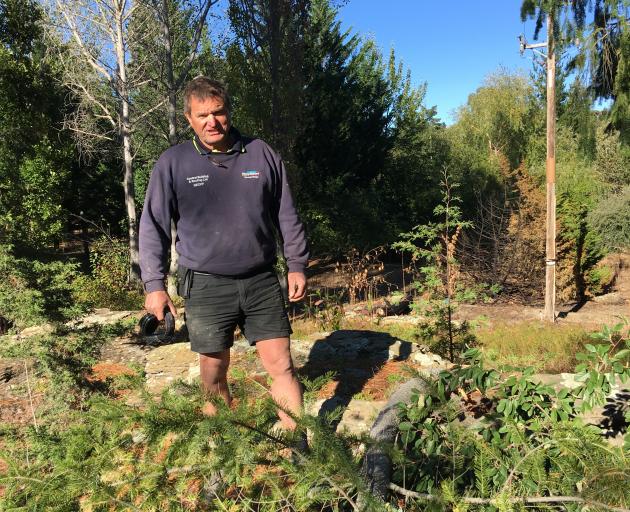
Alexandra Bridge Hill resident Geoff McHardy looks over a tree he believes Aurora Energy claims...
Alexandra Bridge Hill resident Geoff McHardy looks over a tree he believes Aurora Energy claims caused a fire last month near Jolendale Park by falling and touching a power line.
A group of Alexandra residents is worried power lines and poles running through Bridge Hill are in such poor condition they could cause fires and even electrocution.....
......Bridge Hill residents Ken Churchill, Geoff McHardy, Glenda Thompson, Ingrid Mueller and Chris Aquilina-Roberts say they "utterly reject'' the recent explanation of an Aurora manager that a fire caused by a power line near Jolendale Park last month was caused by a tree falling on to the power line...........
www.odt.co.nz/regions/central-otago/fears-over-power-lines-poles


Fears over power lines, poles


Alexandra Bridge Hill resident Geoff McHardy looks over a tree he believes Aurora Energy claims...
Alexandra Bridge Hill resident Geoff McHardy looks over a tree he believes Aurora Energy claims caused a fire last month near Jolendale Park by falling and touching a power line.
A group of Alexandra residents is worried power lines and poles running through Bridge Hill are in such poor condition they could cause fires and even electrocution.
The residents are so concerned they have invited Aurora Energy chief executive Dr Richard Fletcher to meet them and inspect the power infrastructure going up Bridge Hill through Jolendale Park towards State Highway 8......www.odt.co.nz/regions/central-otago/fears-over-power-lines-poleshis website
Facebook comment:
The line broke and started the fire... no tree fell on the line. The lines are all sagging and need fixing. Given the lines run through a park full of trees, surrounded by houses, it would be a very good idea to fix the lines before a tragedy happens.